An actor in a wolf costume lies on a stage and waves under the text Chat with the Sand Wolf

The Sand Wolf

About the project

The Gothenburg Opera had the idea of an AI chatbot based on the character the Sand Wolf from the children's books and the opera of the same name. Our friends at &friends taught an AI to talk to the children in the Sand Wolf's way, and we were responsible for the development.

services

Communication

customer

The Gothenburg Opera
An actor in a wolf costume lies on a stage and waves under the text Chat with the Sand Wolf
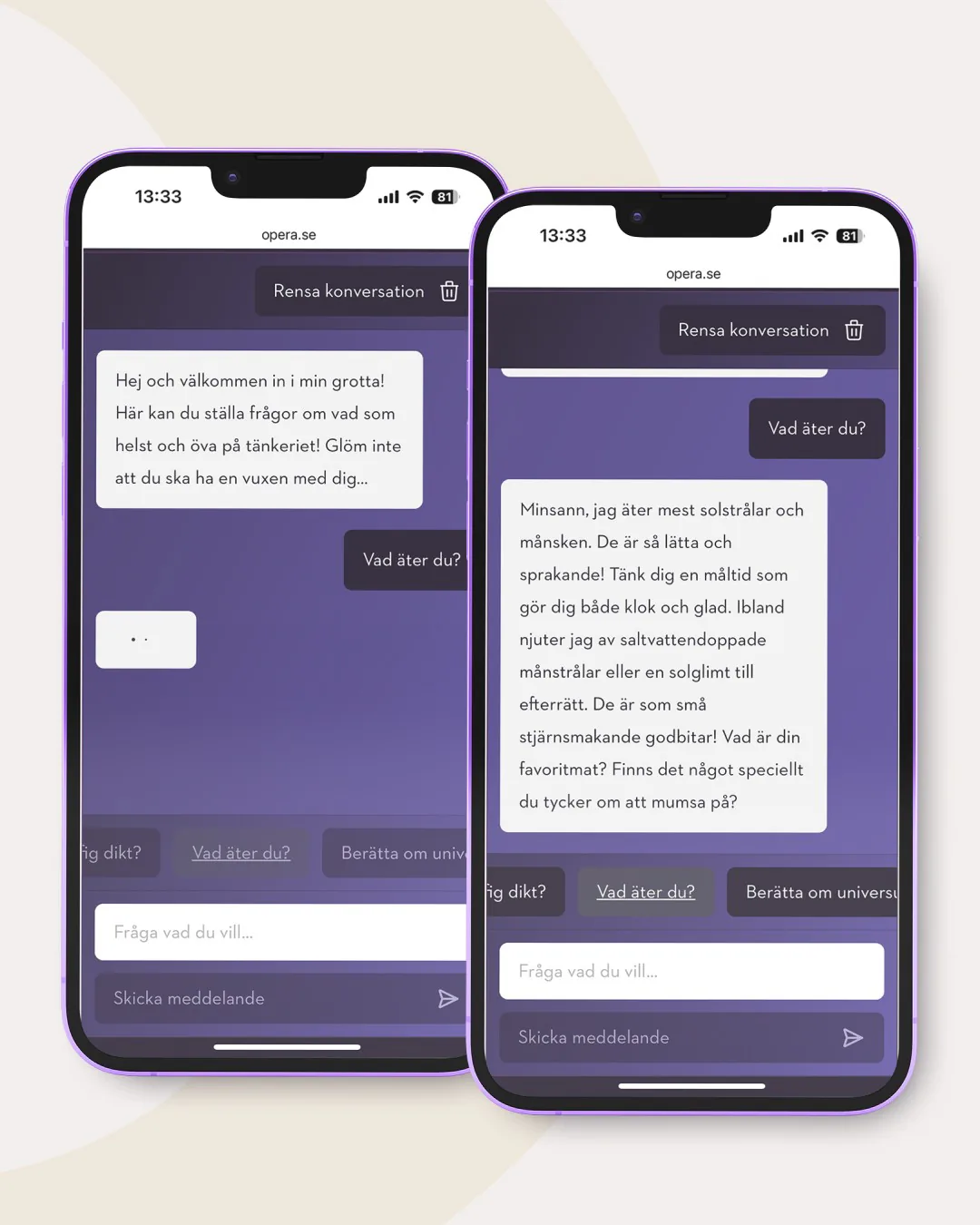
Two mobile phones showing a chat with Sandvargen on opera.se
An actor in a wolf costume lies on a stage and waves under the text Chat with the Sand Wolf
Two mobile phones showing a chat with Sandvargen on opera.se

Dackadida!

The AI chatbot answers children's questions about big and small things in the clever and ingenious way that only the Sand Wolf can. Together with &friends, we created a personalized user interface.

About the technology

The public sector cannot use AI with servers in the US. Therefore, we created a widget for the chatbot using React/NextJS, which in turn communicated with a proprietary API layer. We hosted the entire solution within the EU via the company Scalingo, which was simple, cost-effective, and fully in line with the City of Gothenburg's data and security policies. Our API, in turn, communicated with a Chatbase bot, which our colleagues at &friends had trained to behave exactly like the Sand Wolf.

FAQ

Do you build both web and app?

Yes. Websites, apps, and digital services, from user research to production and operation.

The way of working looks the same regardless of technology. We start with the users' needs, develop and test a proposal, and then build in steps that can be released continuously rather than in a single large delivery.

We also take over services that someone else has built. We then start with a review of the code, content, and operation, so that you know what you have before we promise anything.

Read more

How do you ensure availability?

WCAG is part of the build from the start, not an afterthought review. For legal requirements such as EAA, LPTT, and DOS, we connect the accessibility service.

In practice, this means that contrasts, keyboard navigation, heading structure, and screen reader support are handled when the interface is designed and coded, long before it is to be delivered.

We test continuously using both tools and by hand. Automated tests catch some of the requirements; the rest require someone to sit down with a keyboard and screen reader.

Read more

More cases